When you want warmth in seconds, not minutes, a quartz heater is the answer. The halogen tubes behind the grill glow the moment you switch on, and the heat hits you immediately. That makes quartz heaters the natural choice for a desk, a small office, a shop counter or a bedsitter. Here is how the models we sell compare.
How quartz heating works
A quartz heater uses halogen tubes that produce radiant heat directly, with no warm-up period and no fan. You feel the warmth instantly, and it stops just as fast when you switch off. The trade-off: it warms what is in front of it, not the whole room, and the grill gets hot, so it belongs out of reach of children and pets.
Small desks and counters: 400 to 800W
For a study desk, a shop counter or a bedsitter, an 800W model is plenty. Three options in our range:
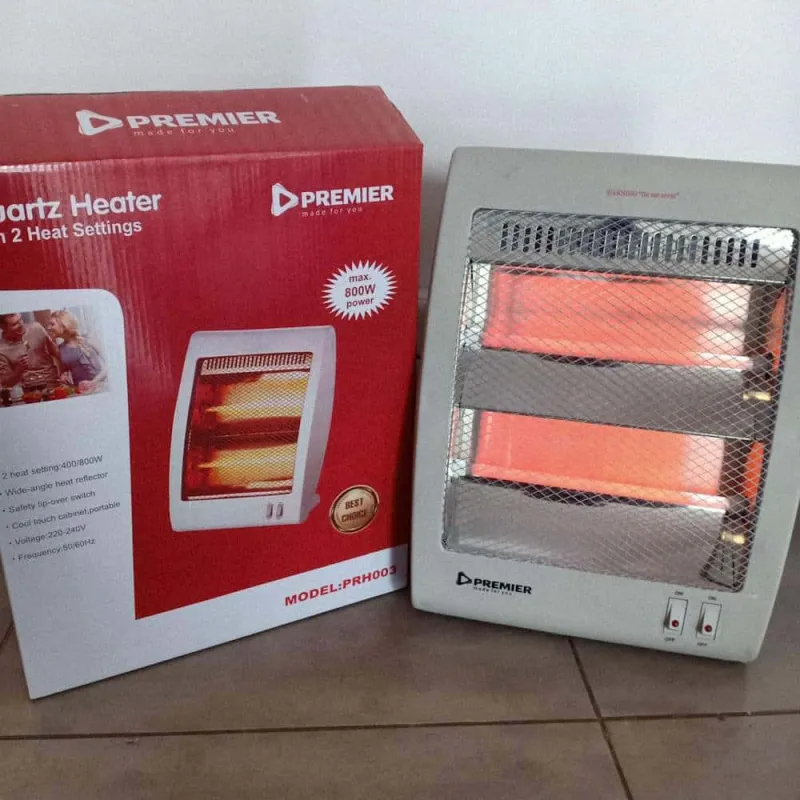
- Premier 400/800W: two heat settings in a fire-resistant ABS body, the straightforward budget pick for a small room.
- NUNIX NH-02 800W: two halogen tubes behind a safety grill, with a tip-over switch. Compact and dependable for a desk or counter.
- Estia EST-HW81 double quartz: two quartz rods with a wide-angle reflector that throws heat across a room up to about 10 square metres.
Bigger rooms and groups: 1600W
When several people share the warmth, step up to 1600W. The Rashnik four-sided quartz heater is the unusual one here: it heats in every direction at once instead of from a single face, which makes it a good fit for a family sitting room, a salon or a workshop where people sit around it.
The Premier 1600W pairs halogen heat with two features you rarely see together: a built-in humidifier and a quiet fan that pushes warm air into the room. For anyone who finds radiant heaters drying, this is the model that fixes that complaint.
Using a quartz heater well
- Point it at people, not walls. Radiant heat warms what it faces. Aim it at the desk or the sofa, and it will not waste heat on the ceiling.
- Give it space. Keep at least a metre clear of curtains, paper and bedding. The grill gets hot enough to scorch.
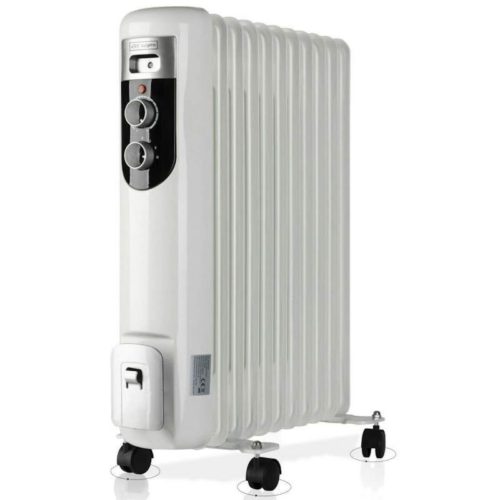
- Use it for short bursts. Quartz is perfect for warming a room for an hour of work. For all-night warmth, an oil-filled radiator is the better tool.
The quick picks
- Desk or counter: the Estia double quartz or the NUNIX 800W.
- Budget small room: the Premier 400/800W.
- Group warmth in every direction: the Rashnik 1600W four-sided.
- Dry air bothers you: the Premier 1600W with humidifier.
Deciding between quartz and oil-filled? The buying guide explains the difference, and the running cost guide shows what each type costs per hour.
Frequently Asked Questions
Do quartz heaters heat a whole room?
No. They warm what is in front of them, which is exactly right for desks, offices and counters. For whole-room warmth, choose an oil-filled radiator or a fan heater instead.
Are quartz heaters safe?
Yes, when used properly. Choose models with a safety grill and tip-over switch, keep the heater a metre from anything flammable, and never cover it. They are not the best choice for children's rooms, where an oil heater is safer.
How much power does a quartz heater use?
It depends on the setting. An 800W heater on full uses 0.8 units per hour, a 1600W uses 1.6 units per hour. The running cost guide works through the math with current KPLC rates.
Why does my quartz heater dry the air?
Radiant heat does not dry air the way fan heaters do, but some people still notice it. The Premier 1600W model includes a built-in humidifier to counter exactly that.