Every serious flashlight in Kenya runs on the same family of cells: 18650, 26650 and 21700 lithium batteries. They are cheap, rechargeable and replaceable, and understanding four simple things about them, protection, terminal, capacity and discharge rate, makes you a smarter buyer. This guide covers all four using the cells we sell.
The sizes: what the numbers mean
The numbers are dimensions in millimetres. An 18650 is 18mm wide and 65mm long, the standard flashlight cell. A 21700 is 21mm by 70mm, a bigger cell with more capacity that newer high-end torches use. A 26650 is 26mm by 65mm, a wider cell for heavy-duty lights. They are not interchangeable; the torch decides which size it takes, so buy the size your light was built for.
Protected vs unprotected: the safety question
This is the decision that matters most.
A protected cell has a small protection circuit built into the battery that guards against overcharge, over-discharge and short circuit. It is the safe choice for flashlights and general use, and it is what we recommend to almost every buyer. Most of the Klarus and WUBEN cells we sell, like the Klarus 18650 2600mAh and the WUBEN 18650, are protected button-top cells.
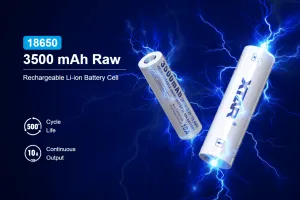
An unprotected cell has no circuit, which means slightly more capacity in the same shell and a higher discharge rate. It is for devices that have their own protection built in, like vape mods and some high-drain torches. The LiitoKala Lii-40A and the XTAR RAW cells are unprotected high-drain cells, and they are excellent, as long as the device handles them safely.
Button top vs flat top
The top of the cell is either a raised button or flat. Button-top cells make contact with spring contacts and older torch designs; flat-top cells fit devices built for them, especially newer lights and vape mods. Check your torch before buying, because a flat-top cell will not make contact in a torch designed for button tops, and vice versa. When in doubt, button top is the safer default for flashlights.
Capacity and discharge: mAh and amps
mAh is the fuel tank, how long the cell runs between charges. A 2600mAh 18650 runs a moderate torch for hours; a 4000mAh 18650 runs it far longer. The Klarus 18GT-36 at 3600mAh with a 7A discharge is the balanced pick for torches with turbo modes.
Discharge rate (amps) is how much current the cell can deliver at once. High-lumen torches and vape mods need high-drain cells: the XTAR 20/30A 18650, the XTAR 35 to 90A 21700, or the LiitoKala Lii-40A at 40A. A low-drain cell in a high-drain device gets hot, which is exactly the failure mode to avoid.
The USB-C convenience: charge without a charger
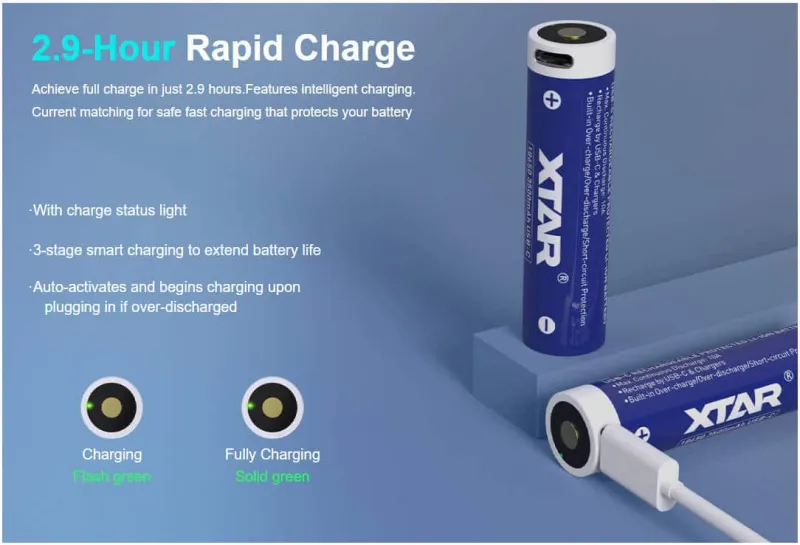
Several XTAR cells now charge directly from USB-C, no separate charger needed. The XTAR 18650 with USB-C and the XTAR 21700 with USB-C plug into any phone charger or power bank. It is a useful feature for travellers and anyone who does not want to carry a charger. For the full charger range, see our battery charger guide.
Buying rules for Kenya
- Match the size to the device. 18650, 21700 and 26650 are not interchangeable.
- Prefer protected for flashlights unless the device handles raw cells.
- Buy spares. Two cells and a charger beat any single battery, because you always have one charged.
- Store loose cells safely. A spare 18650 in a pocket with coins can short and get hot. Carry them in a case.
Browse the full 18650 and 21700 ranges, and pair your cells with the long-range flashlight guide if you are building a kit from scratch.
Frequently Asked Questions
What is the difference between protected and unprotected batteries?
A protected battery has a built-in circuit against overcharge, over-discharge and short circuits, and is the safe default for flashlights. An unprotected battery has no circuit, offers higher discharge rates, and is for devices with their own protection, like vape mods.
Are 18650 and 21700 batteries interchangeable?
No. They are different sizes and the device decides which it accepts. Always check what your flashlight takes before buying.
Can I charge an 18650 with a phone charger?
Only with the USB-C rechargeable cells, like the XTAR 18650 with built-in USB-C. Standard cells need a proper battery charger, which is covered in our charger guide.
Why does my battery get hot in my flashlight?
Either the cell is not rated for the current the torch draws, or the torch is being run at maximum for too long. Match the discharge rate to the device and use high-drain cells for high-lumen torches.