If your home runs on solar with KPLC as backup, or a generator for outages, you have probably stood in the dark flipping a changeover switch and hoping you hit the right position. An automatic transfer switch does that job for you, in seconds, without human hands. This guide explains how ATS units work, how to size one, and the models we sell in Kenya.
What an ATS actually does
An ATS watches two power sources, your main supply and your backup, and switches the load between them automatically. When the main supply fails, it moves the load to the backup. When the main returns, it moves back. The whole point is speed and safety: no fumbling in the dark, no risk of backfeeding the grid, no half-on circuits. For homes on solar plus KPLC, the ATS also decides which source powers the house depending on what is available and, on some models, on battery state.
Transfer time: the number that matters
Transfer time is how long the lights stay off during the switch, and it varies a lot between models:
- Under 50 milliseconds: fast enough that most electronics never notice. The TOMZN TOQ7 switches in under 50 ms, which is the level to look for if you run computers, routers or medical equipment.
- 1 to 4 seconds: standard for most home ATS units. Lights blink, the fridge compressor resets, and everything comes back. Fine for lighting and appliances, not for sensitive electronics.
- Under 16 milliseconds: the level of the Moes inverter ATS, aimed at off-grid solar systems where the inverter must never see a gap.
The TOMZN range we sell
Three TOMZN models cover most Kenyan installations:
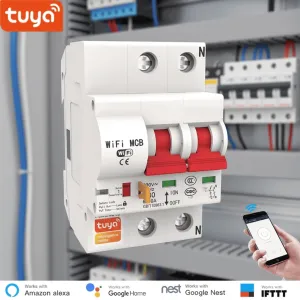
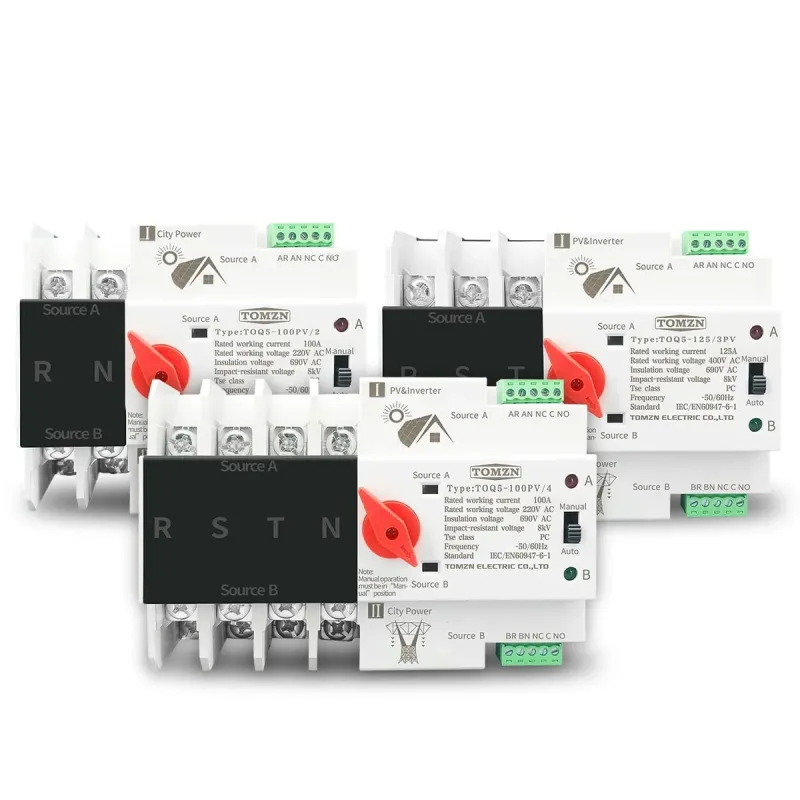
The TOMZN 63/100A is the home standard: it moves the load between solar, generator and KPLC in under 4 seconds, rated at 220V, DIN rail mounted. This is the model we recommend for a normal house with a generator or a solar inverter, and it has been our best-selling ATS by a wide margin.
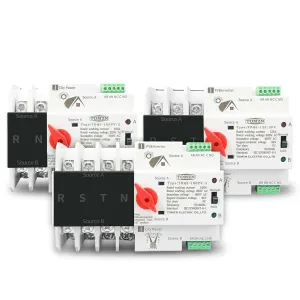
The TOMZN TOQ3-125 steps up to 125A with a 4-pole design for single or three phase 230V/400V systems, with copper contacts, LED source indicators and IEC 60947 rating. It is the pick for bigger homes, workshops and businesses switching to a generator or inverter.
The TOMZN TOQ7 4P is the three-phase unit for workshops and commercial premises, switching all three phases plus neutral between generator and KPLC in under 50 milliseconds, with automatic or manual modes.
Solar-specific ATS: the Moes
Off-grid solar systems have a different need. The Moes Katko 11kW ATS watches your battery voltage and switches to KPLC the moment it drops too low, then back to solar when it recovers. It handles 12V, 24V or 48V DC systems, switches in under 16 milliseconds, and shows system status on an LCD. For a solar home where the inverter must never drop the load, this is the specialist choice.
Sizing: amps, phase and source
Three questions decide the model:
- How many amps? Match the ATS to your main breaker. 63A suits most homes, 100A and 125A suit bigger houses and businesses. Undersizing a changeover switch is how they fail early.
- Single or three phase? Kenyan homes are single phase. Workshops, pumps and commercial premises may be three phase, which needs a 3P or 4P unit like the TOQ7.
- What are the sources? Generator and KPLC needs a standard ATS. Solar battery systems need one that understands battery voltage, like the Moes.
Installation note
An ATS connects to the mains supply, so installation belongs to a qualified electrician. It mounts on the DIN rail beside your breakers, and the electrician wires the two sources in. Once installed, the only thing you notice is that the lights never stay off.
For the solar side of the system, the solar needs guide helps you size the whole setup, and the smart home guide covers the rest of the connected home.
Frequently Asked Questions
Do I need an ATS if I have a generator?
Not strictly, but it is a large safety and convenience upgrade. An ATS switches to the generator automatically when KPLC fails, and switches back when it returns, with no manual changeover and no risk of backfeeding the grid.
How fast should an ATS switch?
For lighting and appliances, a 1 to 4 second switch is fine. For computers, routers and medical equipment, look for under 50 milliseconds, like the TOMZN TOQ7.
What size ATS do I need?
Match it to your main breaker. A 63A unit suits most homes, 100A for larger houses, and 125A for businesses and workshops. When in doubt, go up a size.
Can an ATS work between solar and KPLC?
Yes, but choose the right type. A standard ATS switches between two supplies like solar inverter and grid. For off-grid systems where the inverter must never see a gap, a solar-specific unit like the Moes with battery voltage monitoring is the right choice.