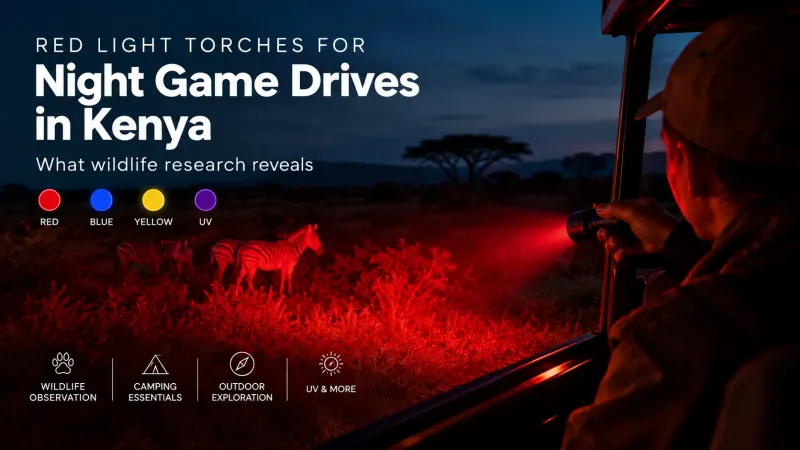
Red Light Torches for Night Game Drives in Kenya: What Wildlife Research Reveals
Kenya's wildlife experiences do not end at sunset. From guided night game drives to camping trips and outdoor exploration, darkness offers a different way to experience nature. But choosing the right flashlight matters, especially when observing nocturnal animals.
Red, blue and yellow light torches are available for different outdoor applications, while ultraviolet (UV) torches offer an additional option for specialist nature exploration. So, which colour should you choose for a night game drive, and is there scientific evidence that red light is better for wildlife observation?
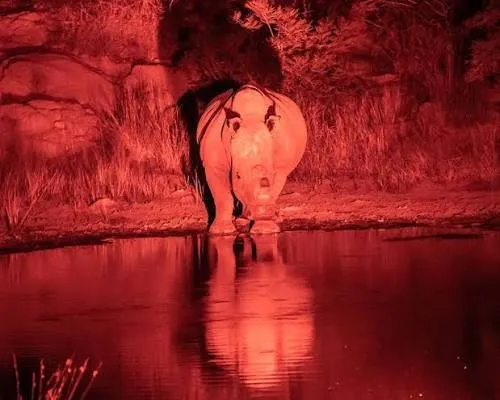
Research published in 2025 provides an interesting answer. It also connects directly to a practical requirement at Soysambu Conservancy in Kenya, where spotlights used during night game drives must have red filters.
1. Why Soysambu Conservancy requires red-filtered spotlights
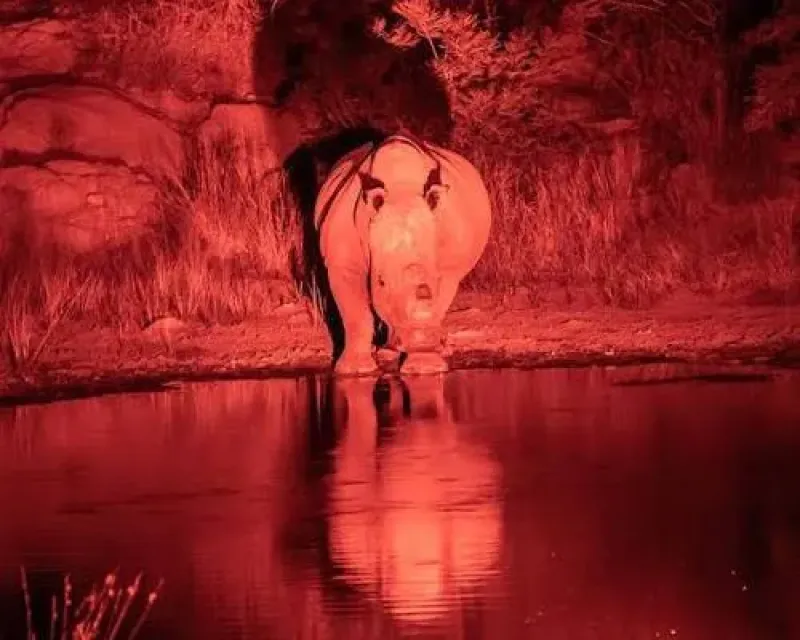
<Entity value="Soysambu Conservancy" category="point_of_interest" location="Nakuru County, Kenya"/> offers guided night game drives, allowing visitors to explore wildlife after dark. Its official night game drive guidelines state that all spotlights must have a red filter. Visitors must also remain inside their vehicles during the drive.
This is a useful example for anyone preparing for a night safari in Kenya. It demonstrates that lighting requirements are not merely a matter of personal preference. They can form part of a conservancy's operating rules.
Red-filtered lighting is relevant because many nocturnal animals are adapted to low-light conditions. Bright artificial light can affect their behaviour, visibility and responses to their surroundings. However, the effect varies between species, and red light should not be treated as completely harmless.
Before purchasing a torch for a safari, check the destination's rules and ask your guide which lighting equipment is permitted.
2. What a 2025 wildlife study discovered about red and white light
A scientific paper published in Mammal Research on 6 September 2025 examined methods for observing nocturnal mammals in tropical forests in Peninsular Malaysia and Brunei Darussalam.
The researchers compared three methods: a conventional white-light head torch, a red-filtered head torch and a red-filtered torch used alongside a thermal imaging device.
The findings were notable:
- White light was associated with lower detection of nocturnal mammals than red light.
- Ten species recorded using the other observation methods were not detected with white light.
- Combining red light with thermal imaging significantly improved the detection of individual mammals compared with red light alone.
- The researchers recommended red light for nocturnal mammal surveys, while calling for more research into how different species respond to different lighting conditions.
The study does not prove that red light is always superior in every environment. Its findings came from particular tropical forest sites and selected mammal species, and the researchers acknowledged limitations requiring further investigation.
Nevertheless, it provides a scientific reason to consider red-filtered lighting when observing nocturnal mammals.
Read the original research: Optimising nocturnal mammal surveys in tropical forests: when red light is the key.
For wildlife enthusiasts in Kenya, the important takeaway is that the brightest beam is not necessarily the best choice for every night-time activity.
3. Red light torches: A practical option for night wildlife observation
Red light is worth considering when you need to illuminate an area during a permitted night-time wildlife activity without immediately switching to a powerful white beam.
Its usefulness depends on the animal, the brightness and wavelength of the light, the distance from the animal and the duration of exposure. Red illumination may reduce disturbance in some circumstances, but different species can respond differently.
A red-filtered flashlight is particularly convenient because it allows you to use the ordinary white beam for general tasks and switch to red illumination when appropriate.
Red light torches can be useful for:
- Guided night game drives where red lighting is required or permitted.
- Nocturnal wildlife observation and nature surveys.
- Campsite tasks where a bright white beam is unnecessary.
- Outdoor enthusiasts who want more than one lighting option in a single flashlight.
If you are buying a torch specifically for wildlife observation, consider its beam control and brightness settings as well as its colour. A lower-output red beam may be more practical for nearby observation than a powerful, tightly focused beam.
4. Blue light torches: Useful in some applications, but not a universal wildlife solution
Blue light is another option found in specialist flashlights. However, it should not automatically be considered better for night game drives.
Animals have different visual systems, and their responses to artificial light depend on their species and the lighting conditions. Some research involving nocturnally migrating birds has found that blue light can attract birds under particular experimental conditions. This illustrates why a single light colour cannot be assumed to be harmless to all wildlife.
Blue illumination may be useful for certain specialist inspection tasks and other applications, depending on the equipment. But there is no sound basis for promising that blue light will improve wildlife sightings or prevent disturbance across all animal species.
For a night safari, follow the guide's instructions and the conservancy's rules rather than choosing blue light simply because it looks different from white light.
5. Yellow light torches: Another option for outdoor use
Yellow illumination offers a different beam appearance from conventional white light. Depending on the flashlight, it may come from a dedicated LED or from a yellow filter fitted over a white-light beam.
These arrangements can produce different results. A filter can reduce the amount of light reaching the target, so the brightness of the original flashlight does not necessarily represent the brightness of the filtered beam.
Yellow light can be considered for certain outdoor visibility tasks, but it should not be marketed as automatically wildlife-friendly. Research on cave-roosting bats has shown that responses to artificial light differ with the colour and intensity used, including responses to yellow illumination.
For camping, the practical choice depends on what you need to see, how far away it is and how much illumination is necessary.
If you want to use one flashlight for several activities, a model with interchangeable filters can offer more flexibility than a torch restricted to a single colour.
6. Why a multi-colour flashlight can make sense for camping
A camping trip involves more than observing wildlife. You may need to find your way along a path, organise equipment, check a vehicle or illuminate an area around your tent.
For these everyday tasks, white light remains important. It provides general-purpose illumination, and a focused beam can help you see obstacles at a distance.
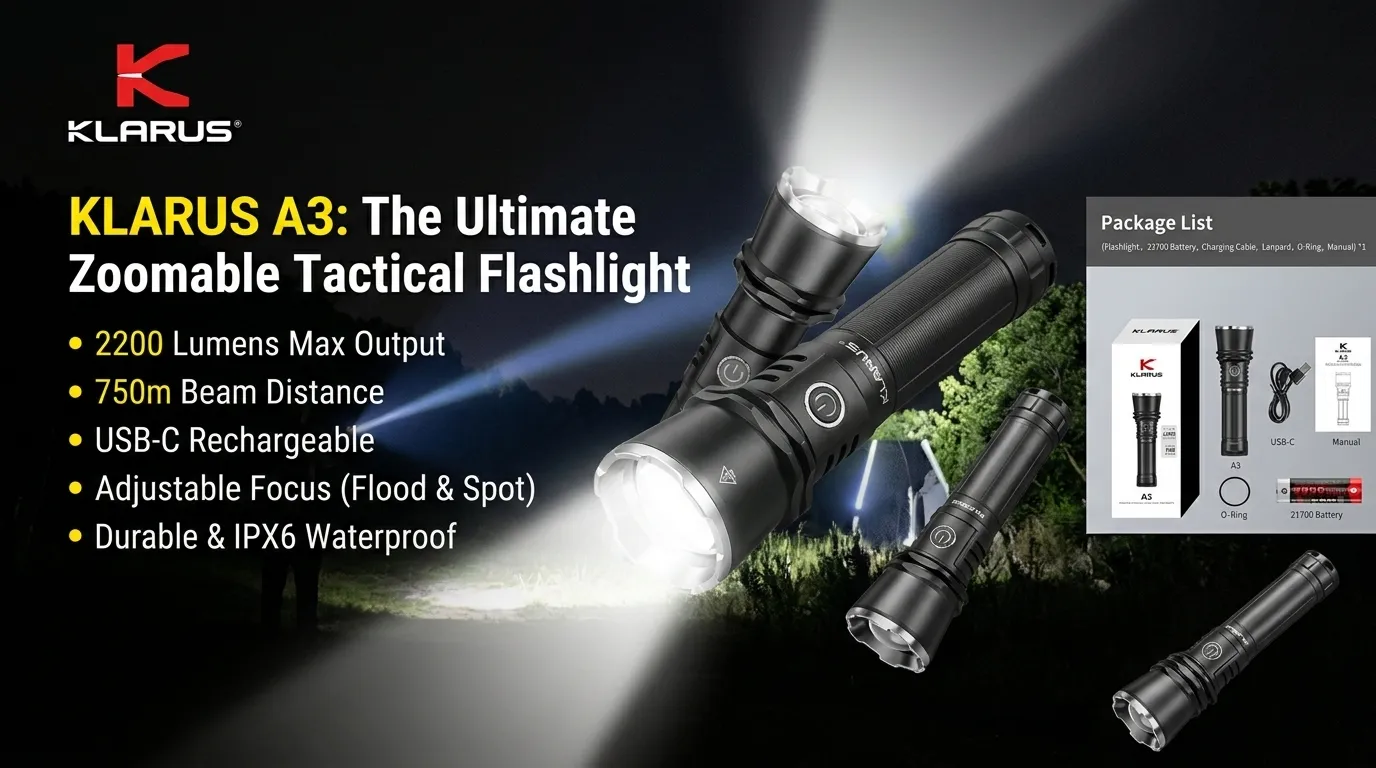
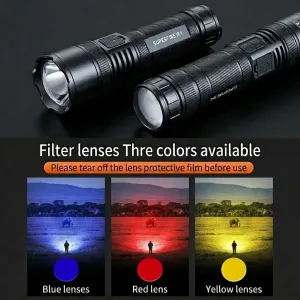
A flashlight with a white beam and interchangeable red, yellow and blue filters lets you adapt the light to different tasks. The original beam remains white; you fit the appropriate filter cap when you want to change the colour.
When comparing models, look at:
- Beam distance: How far the torch can illuminate objects under the manufacturer's stated test conditions.
- Brightness settings: Whether you can reduce output when a powerful beam is unnecessary.
- Battery and charging: Whether the runtime and charging method suit your trip.
- Water resistance: Whether the torch is suitable for the weather and environment you expect.
- Filter design: Whether the colour filters are supplied and can be fitted securely.
- Durability: Whether the construction suits regular outdoor use.
Do not choose a flashlight on advertised lumens alone. Beam shape, intensity at the target, battery performance and ease of use all influence its practical value.
7. UV torches: An extra tool for exploring nature after dark
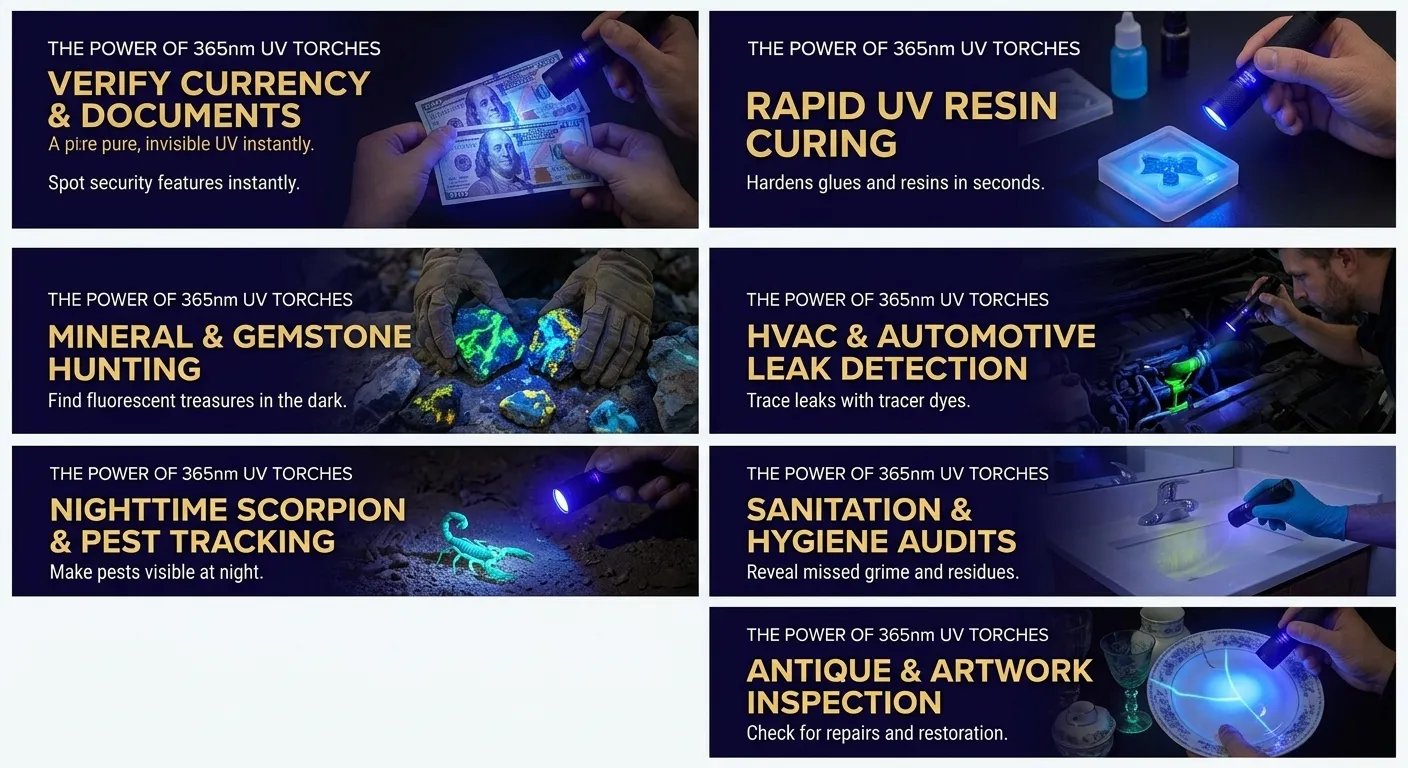
Ultraviolet torches provide a different kind of illumination from red, blue or yellow visible-light filters. They emit ultraviolet radiation that can make certain materials fluoresce, causing them to appear to glow.
One interesting example is scorpion spotting. Many scorpions fluoresce under suitable ultraviolet illumination, making them easier to locate during night-time searches.
This can add another dimension to camping and nature exploration, particularly for people interested in discovering small creatures that are difficult to notice under ordinary lighting.
UV torches can also be used for certain specialist inspection tasks involving fluorescent materials. However, not everything fluoresces, and results depend on the material, the wavelength of the UV torch and the surrounding conditions.
A UV flashlight is not a substitute for a normal camping torch. It is a specialist addition for particular activities. Avoid shining UV light into eyes or unnecessarily exposing skin, and follow the manufacturer's safety guidance.
For wildlife observation, UV illumination should be used only when appropriate for the task. It should not be assumed to be harmless to animals simply because it is invisible or less noticeable to humans.

8. Which torch should you choose for your next Kenyan outdoor adventure?
The right flashlight depends on how you plan to use it.
- For night game drives: Consider a red-filtered flashlight if the operator permits or requires it. Confirm the destination's rules before travelling.
- For camping: Choose a dependable white-light flashlight with useful brightness settings, adequate runtime and suitable water resistance. Additional filters can be useful for specific tasks.
- For multi-purpose outdoor use: A flashlight with interchangeable red, blue and yellow filters offers flexibility without requiring a separate torch for every visible-light colour.
- For specialist nature exploration: Consider a UV torch if you specifically want to observe fluorescence, such as that produced by certain scorpions.
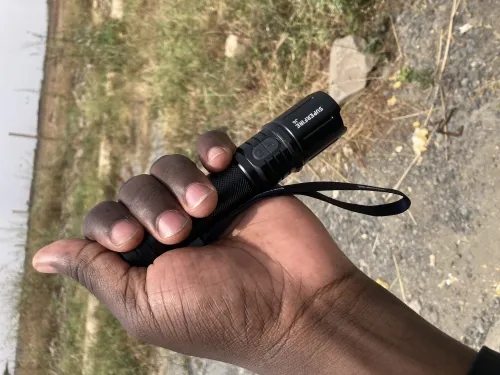
A head torch may be more practical when you need both hands free, while a handheld flashlight may suit tasks requiring a focused beam. A long-range spotlight may be appropriate for certain permitted activities, provided it meets the destination's rules.

9. Responsible lighting is part of responsible wildlife tourism
The objective of a night game drive is to observe wildlife, not to overwhelm animals with artificial light.
Keep beams away from animals when illumination is unnecessary, avoid prolonged direct exposure and follow the guide's instructions. Never chase or surround an animal to get a better view.
Red light may offer advantages in some nocturnal mammal surveys, but no colour guarantees that an animal will remain undisturbed. The intensity, distance, duration and species involved all matter.
Responsible lighting also benefits campers. Switching off unnecessary lights reduces wasted battery power and limits artificial illumination around the campsite.
Find a flashlight for wildlife observation and camping
Preparing for a night game drive or camping trip starts with choosing lighting that suits your planned activities.
Red-filtered torches are worth considering for permitted nocturnal wildlife observation. Blue and yellow illumination have their own potential applications, while white light remains essential for general outdoor visibility. UV torches offer an additional option for specialist nature exploration.
At Lumen Vault, explore flashlights for camping, outdoor use and specialist lighting needs. Compare the beam, battery performance and available filters to find a model that suits your next adventure.
Explore flashlights at Lumen Vault: https://www.lumenvault.co.ke/
Research and references
- Soysambu Conservancy, Day and Night Game Drives. Official information about guided night game drives and red-filtered spotlights.
- Miard, P. et al. (2025), Optimising nocturnal mammal surveys in tropical forests: when red light is the key, Mammal Research, 70, 445–464.
- Blue light attracts nocturnally migrating birds. Research on the effects of artificial light colour on nocturnally migrating birds.
The findings discussed above concern specific study conditions and animal groups. They should not be interpreted as universal guarantees about the effects of any torch colour on wildlife.